What is Accrual Accounting? When to do accrual accounting?
The accounting rules outlined in GAAP, require that most companies keep their accounting records on the accrual basis. The alternative is the cash basis, meaning a transaction is recorded only when cash changes hands.
Cash basis accounting is not considered indicative of economic realities, thus the requirement for accrual accounting except for certain kinds of companies, such as very small businesses and some not-for-profit organizations.
When the Sales Department obtains an order from one of your customers and the product is shipped to the customer, a sale has been consummated and it is recorded. This transaction will appear on the income statement even though not a single dollar may have passed from the customer to your company, because the customer has an open account with the company.
The transaction is recorded by increasing Sales and by increasing Accounts Receivable, the amount due from your customer. Later on, perhaps the following month, your customer pays his or her bill and your company receives the cash.
That transaction will not appear on the income statement. It was already recorded as income when the sale was made and, under accrual accounting rules, only the sale itself is considered an income producing event, not the act of collecting the money.
This example demonstrates the essence of accrual basis accounting. Transactions are recorded when an economic event is deemed to have occurred.
A sale is an economic event because a binding agreement has been reached: your customer agreed to accept the merchandise and pay for it in due course and your company shipped the merchandise on your customer’s promise to pay. That is an economic event, an offer made and accepted.
The customer’s payment is another economic event. It is related to the first, but it is nevertheless a new event. The customer might have chosen to delay his or her payment or return the merchandise, but chose instead to pay for it.
The second economic event doesn’t affect Sales. However, it affects the balance in the customer’s account and it increases your company’s cash receipts.
So when this transaction is recorded, Accounts Receivable and Cash are the accounts that are affected. This transaction, although not shown on the income statement, will be included in the statement of cash flow, which documents transactions other than those that affect income and expense.
Showing posts with label Accounting. Show all posts
Showing posts with label Accounting. Show all posts

GAAP: Generally Accepted Accounting Principles BASIC INFORMATION AND TUTORIALS
What is GAAP (Generally Accepted Accounting Principles)?
GAAP SIMPLIFIED AND EXPLAINED!!!
Generally Accepted Accounting Principles (GAAP)
A set of rules, conventions, standards, and procedures established by the Financial Accounting Standards Board for reporting financial information.
The standard format for recording and reporting financial transactions is outlined in guidelines, or rules, called Generally Accepted Accounting Principles (GAAP). These guidelines are published by the accounting profession (with some gentle help from the U.S. government).
They are intended to be the foundation upon which report readers can gauge a company’s progress, compare one company or one accounting period with another, and generally judge the financial effectiveness of its management efforts.
As we’ve seen, it doesn’t always work out that way, but that’s not necessarily because the rules are flawed. The job of creating comparable accounting and reporting standards for businesses as widely varied as those operating today can be a daunting task for the folks who set the standards.
The objective of each accounting rule is to record a transaction so that it makes economic sense for the company and for readers of the company’s reports. Yet to achieve that objective, accountants in two dissimilar companies might need to record the same transaction differently you understand how to read and use these primary financial statements, prepared in accordance with GAAP.
You Don’t Get What You Don’t Ask For
Some accounting departments produce reports that they never distribute outside their department, because no one has ever asked for them.
These reports, perhaps produced as part of a standard computerized process or to serve a limited purpose in Accounting, might contain information you have been trying to collect on the back of an envelope for months.
If they don’t know you want it, they’re not likely to go looking for you when it’s printed.Ask what kinds of reports are produced that don’t get distributed, just in case there is a gem hidden in that file cabinet.
Of course, this also applies to reports that aren’t printed but are accessible through your computer network.
BALANCE SHEET BASIC DEFINITION INFORMATION
What Is A Balance Sheet?
The Balance Sheet presents the financial position of a company at a given point in time. It is comprised of three parts: Assets, Liabilities, and Shareholder’s Equity.
Assets are the economic resources of a company. They are the resources that the company uses to operate its business and include Cash, Inventory, and Equipment. (Both financial statements and accounts in financial statements are capitalized.)
A company normally obtains the resources it uses to operate its business by incurring debt, obtaining new investors, or through operating earnings. The Liabilities section of the Balance Sheet presents the debts of the company.
Liabilities are the claims that creditors have on the company’s resources. The Equity section of the Balance Sheet presents the net worth of a company, which equals the assets that the company owns less the debts it owes to creditors.
In other words, equity is comprised of the claims that investors have on the company’s resources after debt is paid off. The most important equation to remember is that
Assets (A) = Liabilities (L) + Shareholder’s Equity (SE)
The structure of the Balance Sheet is based on that equation. This example uses the basic format of a Balance Sheet:

With respect to the right side of the balance sheet, because companies can obtain resources from both investors and creditors, they must distinguish between the two. Companies incur debt to obtain the economic resources necessary to operate their businesses and promise to pay the debt back over a specified period of time.
This promise to pay is based on a fixed payment schedule and is not based upon the operating performance of the company. Companies also seek new investors to obtain economic resources.
However, they don’t promise to pay investors back a specified amount over a specified period of time. Instead, companies forecast for a return on their investment that is often contingent upon assumptions the company or investor makes about the level of operating performance.
Since an equity holder’s investment is not guaranteed, it is more risky in nature than a loan made by a creditor. If a company performs well, the upside to investors is higher.
The promise-to-pay element makes loans made by creditors a Liability and, as an accountant would say, more “senior” than equity holdings, as it is paid back before distributions to equity-holders are made.
To summarize, the Balance Sheet represents the economic resources of a business. One side includes assets, the other includes liabilites (debt) and shareholder’s equity, and Assets = L+E.
On the liability side, debts owed to creditors are more senior than the investments of equity holders and are classified as Liabilities, while equity investments are accounted for in the Equity section of the Balance Sheet.
STATEMENT OF RETAINED EARNINGS BASIC DEFINITION INFORMATION
What Is A Statement Of Retained Earnings?
Retained earnings is the amount of profit a company invests in itself (i.e., profit that is not used to pay back debt or distributed to shareholders as a dividend).
The Statement of Retained Earnings is a reconciliation of the Retained Earnings account from the beginning to the end of the year.
When a company announces income or declares dividends, this information is reflected in the Statement of Retained Earnings. Net income increases the Retained Earnings account. Net losses and dividend payments decrease Retained Earnings.
Here is an example of a basic Statement of Retained Earnings:

As you can probably tell by looking at this example, the Statement of Retained Earnings doesn’t provide any new information not already reflected in other financial statements. But it does provide additional information about what management is doing with the company’s earnings.
Management may be reinvesting the company’s net income into the business by retaining part or all of its earnings, distributing its current income to shareholders, or distributing current and accumulated income to shareholders. (Investors can use this information to align their investment strategy with the strategy of a company’s management.
An investor interested in growth and returns on capital may be more inclined to invest in a company that reinvests its resources into the company for the purpose of generating additional resources. Conversely, an investor interested in receiving current income is more inclined to invest in a company that pays quarterly dividend distributions to shareholders.)
INCOME STATEMENT BASIC DEFINITION INFORMATION
What Is An Income Statement?
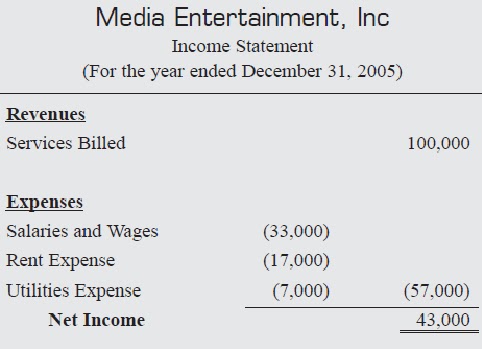
The Income Statement measures the success of a company’s operations; it provides investors and creditors with information needed to determine the enterprise’s profitability and creditworthiness. A company has earned net income when its total revenues exceed its total expenses. A company has a net loss when total expenses exceed total revenues.
A company can obtain resources through its own operations. The Income Statement presents the results of operations of a business over a specified period of time (e.g., one year, one quarter, one month) and
is composed of Revenues, Expenses and Net Income.
Revenue: Revenue is a source of income that normally arises from the sale of goods or services and is recorded when it is earned. For example, when a retailer of roller blades makes a sale, the sale would be considered revenue.
Expenses: Expenses are the costs incurred by a business over a specified period of time to generate the revenues earned during that same period of time. For example, in order for a manufacturing company to sell a product, it must buy the materials it needs to make the product.
In addition, that same company must pay people to both make and sell the product. The company must also pay salaries to the individuals who operate the business. These are all types of expenses that a company can incur during the normal operations of the business.
When a company incurs an expense outside of its normal operations, it is considered a loss. Losses are expenses incurred as a result of one-time or incidental transactions. The destruction of office equipment in a fire, for example, would be a loss.
Assets and expenses
Incurring expenses and acquiring assets both involve the use of economic resources (i.e., cash or debt). So, when is a purchase considered an asset and when is it considered an expense?
Assets vs. expenses: A purchase is considered an asset if it provides future economic benefit to the company, while expenses only relate to the current period. For example, monthly salaries paid to employees for services they already provided to the company would be considered expenses.
On the other hand, the purchase of a piece of manufacturing equipment would be classified as an asset, as it will probably be used to manufacture a product for more than one accounting period.
Net income:The Revenue a company earns, less its Expenses over a specified period of time, equals its Net Income. A positive Net Income number indicates a profit, while a negative Net Income number indicates that a company suffered a loss (called a “net loss”).
Here is an example of an Income Statement:
INTERNAL FUNCTIONS OF ACCOUNTING BASIC INFORMATION AND TUTORIALS
Ask people to describe accounting and the most common answer you’ll get is that accounting involves a lot of record keeping and bookkeeping. Which is true. The accounting system of a business is designed to capture and record all its transactions, operations, activities, and other developments that have financial consequences.
An accounting system generates many documents, forms, and reports. Even a small business has hundreds of accounts, which are needed to keep track of its sales and expenses, its assets and liabilities, and of course its cash flows.
Accounting systems today are computer-based. The accounts of a business are kept on the hard disks of computers, which should be backed up frequently of course.
The primary purpose of an accounting system is to accumulate a complete, accurate, and up-to-date base of data and information needed to perform essential functions for a business.
In addition to facilitating day-to-day operating activities, the accounting department of a business has the responsibility of preparing two different kinds of internal reports—very detailed reports for management control and much more condensed reports for decision making. Likewise, the accounting department prepares two different kinds of external reports— financial reports for owners and lenders and tax returns for tax authorities.
Accountants have a relatively free hand in designing control and decision-making reports for managers. In sharp contrast, external reporting is compliance-driven External financial reports must comply with authoritative standards and established accounting rules. And, as I’m sure you know, tax returns must comply with tax laws.
In addition to the day-to-day operational demands (preparing payroll checks, paying bills on time, sending out invoices to customers, etc.). Management control demands attention to a very large number of details; quite literally, thousands of things can go wrong. Management decision making, in contrast, focuses attention on relatively few key factors.
Decision making looks at the forest, not the trees. For decision-making purposes, managers need accounting reports that are condensed and global in nature—that present the big picture.
These reports should resonate with the business model and should be structured according to the profit and cash flow models of the business. In passing, I should mention that accounting information seldom comprises the whole set of information needed for decision making and control.
Managers use many, many other sources of information—competitors’ sales prices, delivery problems with suppliers, employee morale, and so on. Nonaccounting data comes from a wide diversity of sources, including shopping the competition, sales force reports, market research studies, personnel department
records, and so on.
For example, customer files are very important, and they usually include both accounting data (past sales history) and nonaccounting data (sales reps assigned to each customer).
EXTERNAL FUNCTIONS OF ACCOUNTING BASIC INFORMATION AND TUTORIALS
Accountants have two primary external reporting responsibilities: the preparation of tax returns and external financial reports. Exceedingly complex and constantly changing laws, rules, and forms govern state and federal income taxes, payroll taxes, property taxes, and sales taxes.
Accountants have their hands full just keeping up with tax regulations and forms. Accountants also have to stay abreast of changing accounting standards to prepare external financial reports.
The financial statements of a business that are the core of the external financial reports sent to its share owners and lenders must conform with generally accepted accounting principles (GAAP). These are the authoritative guidelines, rules, and standards that govern external financial reporting to the outside investors and creditors of a business.
The main purpose of having financial statements audited by an independent CPA firm is to test whether the statements have been prepared according to GAAP. If there are material departures from these ground rules of financial statement accounting and disclosure, the CPA auditor says so in the audit opinion on the financial statements.
External financial reports include footnotes that are an integral addendum to the financial statements. Footnotes are needed because the external financial report is directed to outside investors and creditors of the business who are not directly involved in the day-to-day affairs of the business.
Managers should already know most of the information disclosed in footnotes. If managers prefer to have certain footnotes included in their internal accounting reports, the footnotes should be included—probably in much more detail and covering more sensitive matters than footnotes presented in external financial reports.
An external financial report includes three primary financial statements: One summarizes the profit-making activities of the business for the period; one summarizes the cash inflows and outflows for the same period; and one summarizes the assets of the business at the end of the period that are balanced by the claims against, and sources of, the assets.
The three primary financial statements do not come with built-in analysis. Rather, the financial statements provide an organized source of information. It’s up to the users to extract the vital signals and messages from the statements.
Subscribe to:
Posts (Atom)